
AI-powered advertising is becoming an important part of digital marketing in 2026. As artificial intelligence changes how people search, discover products, compare options, and make decisions, businesses are exploring new ways to reach potential customers.
Traditional advertising often depends on keywords, demographics, interests, and browsing behavior. Conversational AI introduces a more contextual approach by understanding what users are asking and the intent behind their questions.
This shift is creating growing interest in Chat GPT Ads. Instead of reaching users only through traditional search results or social media feeds, businesses can explore advertising opportunities within conversational experiences.
The development of open ai advertising also reflects the broader movement toward AI-powered marketing. For businesses, this could create new opportunities to connect with customers when they are actively looking for information, solutions, products, or services.
A chat gpt advertisement can be different from a traditional banner or search ad. In a conversational environment, relevance and context can play an important role in how advertising is presented and experienced.
The growing conversation around ads on Chat GPT also shows how customer discovery is evolving. People are increasingly using conversational tools to ask questions, research products, and explore recommendations.
For digital marketers like digital by Ritika , this development is worth paying attention to. AI-powered advertising could influence how brands approach targeting, messaging, customer journeys, and campaign measurement.
Businesses that understand these changes early can prepare their digital strategies for an increasingly AI-driven advertising environment. The goal is not simply to follow a new trend, but to understand how changing user behavior can create new opportunities for meaningful brand connections.
What Are Chat GPT Ads?
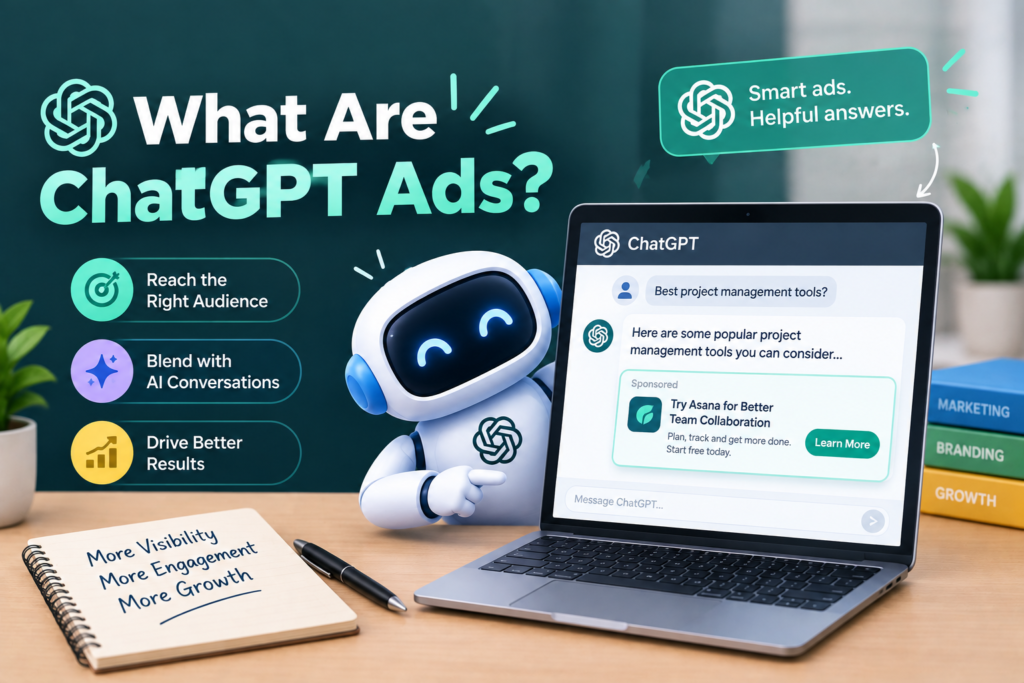
Chat GPT Ads refer to a developing form of AI-powered advertising designed around conversational digital experiences. Instead of showing an advertisement only after someone searches a keyword or scrolls through a social media feed, this type of advertising can connect with users within an AI-driven environment.
The idea behind open ai advertising is to create advertising experiences that are relevant to the context in which people are interacting with AI. Users may ask questions, explore ideas, research products, or look for solutions, creating a different environment from traditional advertising platforms.
A chat gpt advertisement can therefore be different from a conventional banner, display ad, or search advertisement. Traditional ads often appear based on keywords, demographics, interests, or browsing behavior. Conversational advertising can potentially take the user’s current context and intent into consideration.
For example, someone might use an AI assistant to explore options for planning a trip, choosing software, or finding a service. In a conversational environment, relevant advertising could become part of that broader discovery journey rather than appearing as a separate interruption.
This also changes how businesses can think about reaching customers. With ads on Chat GPT, brands may have opportunities to appear closer to moments when users are actively researching a product, service, or solution. The focus can shift from simply attracting attention to being relevant to the user’s current needs.
Another important difference is the nature of the interaction. Traditional digital advertising often takes users from an advertisement to a landing page, product page, or website. Conversational experiences can involve more natural interactions where users ask follow-up questions and explore information before making a decision.
For businesses, this creates an opportunity to think differently about advertising content. Instead of relying only on catchy headlines or visual creatives, marketers may need to focus more on context, relevance, clarity, and user intent.
As AI-powered advertising continues to develop, businesses will need to understand how users interact with conversational platforms. Chat GPT Ads represent part of a broader shift toward advertising that fits into increasingly intelligent and personalized digital experiences.
How Does Open AI or Chat GPT Advertising Work?
Open AI advertising represents a different approach to digital advertising, where the focus can move beyond simple keywords and audience categories toward understanding the context of a user’s interaction. In a conversational environment, users often explain what they need in detail, giving AI more context about their questions, interests, and intent.
For example, a user might ask for recommendations, compare different products, or look for a specific service. Understanding this context can help determine whether an advertising message is relevant to the conversation rather than simply matching a single keyword.
Relevance is therefore an important part of AI-powered advertising. Users are more likely to find an advertisement useful when it relates closely to what they are currently exploring. This can create a more natural experience compared with ads that feel unrelated to the user’s immediate needs.
For advertisers, campaigns can involve defining objectives, developing suitable creative, identifying relevant audiences or contexts, and monitoring campaign performance. As advertising platforms develop, marketers can use campaign data to understand what is working and make informed adjustments.
A chat gpt advertisement also needs to fit naturally within the broader conversational experience. Clear messaging, useful information, and an appropriate call to action can help businesses communicate their value without making the interaction feel disruptive.
The idea behind ads on Chat GPT also makes responsible advertising especially important. Users should be able to distinguish advertising from organic or AI-generated responses. Clear labeling and transparency can help people understand when they are viewing sponsored content.
Privacy and responsible use of information are equally important. Advertising should respect user expectations and applicable policies while avoiding misleading claims or manipulative messaging.
For digital marketers, this means successful AI advertising is not only about reaching the right person. It is also about delivering the right message in an appropriate context while maintaining trust.
As Chat GPT Ads and other AI advertising formats continue to evolve, businesses will need to balance performance with transparency, relevance, and a positive user experience.
What Is Chat GPT Ads?
A chat gpt advertisement is an advertising message designed for an AI-powered, conversational environment. Unlike traditional ads that usually appear as banners, search listings, or social media posts, this type of advertising can be presented within a context where users are actively asking questions and exploring information.
One of the biggest differences with Chat GPT Ads is context. Traditional advertising often relies on keywords, demographics, interests, or browsing behavior. A conversational environment can provide a richer understanding of what a user is discussing and what they may be trying to accomplish. This creates new opportunities for Chat GPT Ads to deliver more contextually relevant advertising experiences.
User intent is therefore an important consideration in OpenAI advertising. Someone asking about website development may be researching services, comparing providers, or simply learning about the topic. Understanding these different intentions can help businesses create messaging that is more relevant to the user’s situation and explore how advertising within AI-powered experiences can connect with users based on conversational context.
For businesses exploring Chat GPT Ads, the focus should not simply be on promoting a product or service. Advertising content should communicate a clear value and connect naturally with the user’s needs.
Useful messaging can answer a potential customer’s concern, explain a benefit, highlight a relevant solution, or encourage the next step. The goal is to make the advertisement informative and meaningful rather than simply attention-grabbing.
Conversational environments can also create new opportunities for brand discovery. Users may encounter brands while researching a product, exploring solutions, or comparing different options. This can introduce a business earlier in the customer journey.
The concept of ads on Chat GPT also highlights the importance of creating advertising experiences that complement the conversation. Instead of interrupting users with unrelated promotions, relevant advertising can potentially become part of their broader discovery process.
This makes AI-powered advertising different from many traditional formats. The emphasis shifts toward relevance, context, intent, and usefulness rather than relying only on visual appeal or keyword matching.
As open ai advertising continues to develop, businesses will need to understand how conversational interactions influence customer discovery. Brands that focus on clear messaging, genuine value, and relevant customer needs can better prepare for the changing digital advertising landscape.
How Do Ads on Chat GPT Change Digital Marketing?
Ads on Chat GPT are introducing a different way for businesses to connect with potential customers. Traditional digital advertising often starts with keywords, searches, demographics, or browsing behavior. AI-powered advertising adds another layer by considering the context of a user’s conversation and what they are trying to accomplish. (OpenAI Help Center)
This creates a shift from keyword-based search to conversational discovery. Instead of typing a short search such as “best running shoes,” a user might explain their budget, preferences, experience level, and specific requirements in a conversation.
That richer context can help advertising become more relevant to the situation. OpenAI says ChatGPT Ads can consider the context and intent of the current conversation, along with other permitted signals when ad personalization is enabled.
The customer journey can also change.
Traditionally, a customer may search on Google, visit several websites, compare products, see social media ads, and then make a purchase. In a conversational environment, research, comparison, and decision-making can happen within a more connected experience.
This means businesses need to think beyond individual clicks. A chat gpt advertisement can become part of a broader discovery journey where a potential customer is learning about a product or evaluating different solutions.
AI also creates new possibilities for personalized advertising. Instead of using exactly the same message for every audience, advertisers can create multiple variations that communicate different benefits, use cases, or customer needs.
For marketers using Chat GPT Ads, relevance becomes especially important. OpenAI’s current advertising guidance recommends clear, specific, benefit-focused messaging and emphasizes making ads useful to what users are trying to accomplish.
This can encourage brands to improve their messaging. Rather than simply saying that a product is “the best,” businesses can explain who it is designed for, what problem it solves, and why it may be useful.
Another major opportunity is audience engagement. Conversational environments can make advertising feel less like a static promotional message and more connected to the user’s discovery process. OpenAI is also testing experiences such as Sponsored Agents, which can allow people to begin a conversation with a business-sponsored agent after interacting with an ad. (OpenAI)
For digital marketers, this represents a broader shift in how brands can participate in customer discovery.
Open AI advertising is therefore not simply another advertising format. It reflects the growing connection between AI, search behavior, personalization, and customer decision-making.
As ads on Chat GPT continue to develop, businesses will need to focus on useful content, relevant messaging, clear brand communication, and measurable outcomes. The brands that understand conversational intent can prepare themselves for a digital marketing environment where customers increasingly discover and evaluate solutions through AI.
ChatGPT Ads vs. Traditional Digital Advertising
Digital advertising is changing as users increasingly interact with AI to research products, compare options, and make decisions. ChatGPT Ads introduce a conversational advertising environment that differs from traditional platforms such as Google Ads and Meta Ads.
The key difference is how advertising connects with user intent and interaction. Google Ads traditionally connects advertisements with searches and keywords, while Meta Ads has historically provided advertisers with audience-based targeting across social experiences. ChatGPT Ads are designed around the context of conversations and the intent expressed within them. (Google Help)
ChatGPT Ads vs. Google Ads
Google Ads is strongly connected to search behavior. Advertisers can use keywords and match types to determine which searches may make their ads eligible to appear. This makes Google particularly relevant when users actively enter a search query related to a product or service. (Google Help)
Chat GPT Ads approach discovery differently. Users can describe their needs in much more detail through a conversation. OpenAI says its advertising system considers conversational intent and other relevance signals, creating opportunities for ads to align with what users are exploring. (OpenAI Help Center)
ChatGPT Ads vs. Meta Ads
Meta Ads operate across social platforms and provide advertisers with tools for audience targeting, creative formats, campaign objectives, and performance measurement.
ChatGPT advertising is centered on a different type of interaction. Instead of discovering an advertisement while scrolling through social content, users may encounter an ad while researching, comparing, or considering options within a conversation.
This creates a different environment for a chat gpt advertisement, where the relevance of the message and the user’s immediate context can be especially important.
Differences in User Intent and Interaction
The customer journey can also look different.
A person using Google may enter a specific search such as “digital marketing agency for small business.” On social media, someone may discover a service while browsing content. In ChatGPT, the same person might explain their business challenge, budget, goals, and requirements through a longer conversation.
This conversational context can give businesses another opportunity to participate in the discovery process.
Targeting, Messaging, and Measurement
Traditional advertising platforms offer established systems for targeting audiences, selecting keywords or placements, creating campaigns, and measuring performance.
Ads on Chat GPT add conversational context to this process. OpenAI currently provides tools for campaign management and measurement, including CPC bidding and expanded measurement capabilities. (OpenAI)
For marketers, this means messaging needs to become more specific and useful. OpenAI recommends clear, benefit-focused advertising that explains what a product offers, who it is for, and when it may be helpful. (OpenAI Help Center)
Ultimately, open ai advertising does not simply replace Google Ads or Meta Ads. Instead, it adds another advertising environment built around conversation, context, and decision-making. Businesses can consider how each platform fits different stages of their customer journey and use performance data to understand which approaches work for their specific goals.
Benefits of Chat GPT Ads for Businesses
As digital advertising continues to evolve, businesses are looking for new ways to reach customers at the moment they are researching, comparing, and making decisions. Chat GPT Ads create an opportunity to connect with audiences within a conversational environment where people can explain what they need in greater detail.
One of the key benefits is context-driven advertising. Traditional advertising can depend heavily on keywords, audience characteristics, or browsing behavior. ChatGPT Ads can consider the context and intent of the current conversation when determining which advertisements may be relevant. (OpenAI Help Center)
This can help businesses communicate with people who are already exploring a relevant topic. Instead of reaching an audience based only on a broad interest, a chat gpt advertisement can potentially appear when the conversation itself indicates that a product or service may be useful.
Reaching Relevant Audiences
Relevance is particularly important in conversational advertising.
People often use ChatGPT to compare products, explore solutions, plan purchases, or understand their options. This creates opportunities for businesses to reach potential customers during meaningful stages of the customer journey.
OpenAI’s current advertising system uses signals such as conversation context and intent, along with other permitted signals depending on advertising settings. (OpenAI Help Center)
Brand Discovery
Ads on Chat GPT can also create new opportunities for brand discovery. A customer may not know which company can solve their problem, even when they have a clear need.
Being present during this research process can help a business introduce its product or service to potential customers who are actively exploring solutions.
For example, someone researching website development options could discover a relevant web development company while comparing possible approaches. The advertisement becomes part of the discovery journey rather than simply appearing as a separate promotional message.
Personalized Customer Experiences
Another potential benefit is personalization.
Because conversational interactions can contain more detailed context, advertising can be designed around specific customer needs and situations. OpenAI’s current system can use conversation context and, where ads personalization is enabled, certain signals from a user’s broader ChatGPT experience to improve relevance. (OpenAI Help Center)
For businesses, this creates an opportunity to develop clearer and more useful messaging instead of relying on generic promotional statements.
New Opportunities for Conversions
The ultimate goal of advertising is often to encourage meaningful action. Open AI advertising provides businesses with campaign options focused on views, clicks, and supported conversion goals, while Ads Manager provides reporting for metrics such as impressions, clicks, CTR, spend, and conversions. (OpenAI Help Center)
This gives marketers ways to evaluate whether their campaigns are contributing to actual business outcomes.
However, ChatGPT Ads is still an evolving advertising platform, and OpenAI notes that there are not yet broad performance benchmarks across industries and campaign types.
For businesses, the opportunity is therefore not simply about adopting another advertising channel. It is about understanding conversational intent, creating useful messages, reaching relevant audiences, and continuously measuring what works.
With the right strategy, Chat GPT Ads can become another tool businesses use to support brand discovery, customer engagement, and measurable growth in an increasingly AI-driven digital landscape..
How Businesses Can Prepare for Chat GPT Advertising
As AI-powered advertising becomes a growing part of digital marketing, businesses need to prepare for a customer journey that is increasingly conversational. Chat GPT Ads give brands another environment to reach people while they explore options, compare products, and make decisions.
The first step is to create clear and relevant messaging.
A conversational environment requires advertising copy that quickly communicates what a business offers and why it may be useful. OpenAI recommends clear, specific, benefit-focused copy rather than relying only on catchy slogans or generic calls to action.
Businesses should explain the practical value of their product or service. What problem does it solve? Who is it designed for? When would a customer benefit from using it?
The next step is to understand customer intent.
People can use ChatGPT for research, comparisons, planning, recommendations, and many other tasks. This means marketers should identify the questions, problems, and situations that typically lead customers toward their products or services.
For open ai advertising, understanding conversational intent is particularly important because ChatGPT Ads can use signals such as the context and intent of the current conversation when determining ad relevance.
Businesses should also develop useful creative assets.
A strong campaign needs more than a headline. Advertisers can prepare different titles, descriptions, images, and landing pages that communicate different benefits or use cases. OpenAI’s current guidance recommends creating diverse ad variations so the system can identify more relevant opportunities.
This is where a chat gpt advertisement can benefit from having multiple creative angles. One version might focus on affordability, another on convenience, and another on a specific customer problem.
Testing is equally important.
Businesses can test different campaigns rather than assuming that one message will work for every audience or situation. Campaign objectives, budgets, ad groups, creative variations, and context hints can be adjusted based on the business goal.
Finally, businesses should track and optimize performance.
Ads on Chat GPT can be monitored through metrics such as impressions, clicks, spend, CTR, average CPC, average CPM, and conversions when conversion measurement is configured.
Performance data can show which messages attract attention, which campaigns generate engagement, and which approaches contribute to conversions.
However, businesses should avoid expecting instant benchmarks. OpenAI notes that ChatGPT Ads is still an evolving platform and does not yet provide broad performance benchmarks across advertisers, industries, and campaign types.
The best preparation is therefore a combination of clear messaging, customer-intent research, useful creative, structured testing, and continuous optimization.
As conversational advertising develops, businesses that treat Chat GPT Ads as a strategic channel—not simply another place to display an advertisement—can build a stronger foundation for AI-driven customer discovery.
ChatGPT Ads for Small Businesses
For small and growing businesses, reaching the right customers can be challenging. Limited budgets often mean every advertising decision needs to be focused and measurable. Chat GPT Ads are creating another opportunity for smaller brands to connect with people while they research products, compare options, and make decisions.
OpenAI has specifically expanded ChatGPT Ads to businesses of different sizes. Its current advertising platform includes self-serve Ads Manager, making it possible for SMBs and startups to create campaigns, set budgets, launch ads, and monitor performance.
Opportunities for Small and Growing Brands
Small businesses often compete with larger companies that have bigger marketing budgets. A conversational advertising environment can provide another way to introduce a brand when potential customers are actively exploring a particular need.
For example, a local service provider, online store, software company, or growing professional brand can create advertising around specific products, services, or customer problems.
The opportunity is not simply about displaying an advertisement. A chat gpt advertisement can be positioned within a broader discovery journey where customers are already researching possible solutions.
Reaching Relevant Customers
Relevance is especially important for businesses working with limited budgets.
ChatGPT Ads can use multiple signals, including the context and intent of the current conversation, to determine which ads may be relevant. Advertisers can also organize campaigns around specific customer needs and provide context hints describing when their products or services may be useful.
This can help businesses focus their advertising around meaningful customer situations rather than communicating the same message to everyone.
For small brands, that focused approach can make it easier to develop campaigns around specific products, services, locations, or customer needs.
Building Brand Awareness
Ads on Chat GPT can also support brand discovery.
A potential customer may know what problem they want to solve but may not know which brands offer the right solution. Appearing during this research process can give a smaller business an opportunity to introduce itself to a relevant audience.
Consistent, clear, and useful messaging can help customers understand what a brand offers and why it may be worth considering.
Making Advertising Strategies More Focused
Small businesses can benefit from keeping their campaigns specific. Instead of trying to promote everything at once, businesses can create focused ad groups around different products, services, or customer needs.
OpenAI recommends separating meaningfully different use cases and testing different messaging variations within ad groups.
Businesses can then monitor metrics such as impressions, clicks, CTR, CPC, spend, and conversions to understand campaign performance and make adjustments.
This makes open ai advertising an emerging option for small businesses looking to experiment with AI-native customer discovery.
As Chat GPT Ads continue to develop, smaller brands can focus on what matters most: understanding their customers, creating relevant messages, managing budgets carefully, and using performance data to improve their campaigns over time.
Measuring the Success of ChatGPT Ads
Running Chat GPT Ads is only one part of an effective advertising strategy. Businesses also need to understand whether their campaigns are reaching the right audience, generating engagement, and contributing to meaningful business outcomes.
Measurement helps marketers move beyond assumptions and make decisions based on actual campaign data.
Impressions
Impressions show how many times an advertisement was displayed to users. This metric is particularly useful for businesses focused on visibility and brand awareness.
A growing number of impressions can indicate that an ad is receiving exposure, but impressions alone do not show whether people found the message relevant or took action.
OpenAI’s Ads Manager currently provides impression reporting alongside other campaign metrics such as clicks, spend, CTR, average CPC, average CPM, and conversions.
Clicks and Engagement
Clicks provide a clearer indication of user interest.
When someone clicks a chat gpt advertisement, they are taking an additional step beyond simply seeing the ad. Marketers can use clicks and click-through rate (CTR) to understand how effectively their messaging encourages users to explore further.
However, a high CTR does not automatically mean a campaign is successful. Businesses should also examine what happens after the click, including website engagement and conversions.
Conversions
Conversions are often one of the most important metrics for performance-focused campaigns.
A conversion could involve a purchase, lead submission, registration, or another defined customer action. OpenAI currently supports conversion measurement through tools such as the OpenAI Pixel and Conversions API.
This allows businesses to connect advertising activity with specific outcomes rather than measuring visibility alone.
Cost and ROI
Businesses also need to consider how much they are spending to achieve those results.
Ads on Chat GPT currently support different campaign objectives and billing approaches, including CPM, CPC, and conversion-optimized options for eligible campaigns.
Metrics such as average CPC, average CPM, total spend, and conversion results can help marketers evaluate efficiency.
For ROI analysis, businesses can compare the value generated from conversions with the cost of running the campaign. The exact calculation will depend on the business model and the value assigned to each conversion.
Comparing Performance With Other Advertising Channels
Businesses should also compare open ai advertising with their existing marketing channels.
For example, marketers may compare ChatGPT Ads with Google Ads, Meta Ads, email campaigns, or other paid channels using relevant metrics such as CTR, CPC, conversion rate, cost per acquisition, and ROI.
However, comparisons should be made carefully. Different platforms use different attribution methods, reporting windows, and measurement systems. OpenAI notes that conversion totals can differ between Ads Manager, analytics providers, and other advertising platforms for these reasons.
Since ChatGPT Ads is still evolving, OpenAI also notes that broad performance benchmarks across industries and campaign types are not yet available.
The most useful approach is therefore to establish clear campaign goals, track the right metrics, compare results consistently, and optimize based on actual performance.
For businesses investing in Chat GPT Ads, effective measurement can turn campaign data into practical insights and help improve future advertising decisions.
The Future of AI-Powered Advertising
The future of digital advertising is becoming increasingly connected to artificial intelligence. As people use AI to research products, compare options, solve problems, and make decisions, advertising is moving beyond traditional search and social media environments.
Chat GPT Ads are an early example of this shift. OpenAI describes ChatGPT as an advertising environment built around conversation, context, and real-time decision-making, giving businesses opportunities to reach customers while they explore and evaluate different options.
Growth of Conversational Advertising
Conversational advertising can change how brands communicate with potential customers.
Traditional advertisements generally present a fixed message. In an AI-powered environment, the surrounding conversation can provide richer context about what a person is trying to accomplish.
This creates opportunities for advertising to become more relevant to the user’s current situation. OpenAI’s current system considers signals such as conversation context and intent when selecting ads, rather than relying only on traditional keyword matching.
The development of Sponsored Agents also points toward more interactive advertising experiences. OpenAI is currently testing Sponsored Agents that allow users to start a clearly labeled conversation with a business-sponsored agent after interacting with an ad.
Changing Role of AI in Customer Discovery
AI is increasingly becoming part of the customer discovery process.
Instead of visiting multiple websites to understand a product or service, users can ask detailed questions and explore different possibilities through a conversation. This can influence how customers discover brands and evaluate their options.
For marketers, a chat gpt advertisement therefore needs to do more than attract attention. It should communicate a clear benefit and fit the context in which the customer is making a decision.
Future Opportunities for Advertisers
The development of open ai advertising is creating opportunities around more contextual creative, campaign automation, measurement, and interactive brand experiences.
OpenAI is already introducing AI-powered tools that can help advertisers create, update, and analyze campaigns, while new integrations and advertising formats are expanding the capabilities of its advertising platform.
For businesses, this could mean spending less time managing repetitive advertising tasks and more time developing strong strategies, creative ideas, and customer experiences.
Why Businesses Need to Adapt
Businesses do not necessarily need to abandon traditional advertising. Instead, they need to understand how AI-powered channels can complement existing strategies.
Ads on Chat GPT represent one part of a broader change in how people discover information, products, and services. Search engines, social platforms, websites, email, and AI conversations can all play different roles in the customer journey.
This makes adaptability increasingly important.
Businesses should focus on understanding customer intent, creating useful content, developing flexible creative assets, and measuring performance across channels. They should also stay informed as AI advertising platforms introduce new formats, targeting options, and measurement capabilities.
The future of advertising is unlikely to be defined by one platform alone. Instead, it will be shaped by how effectively businesses combine technology, creativity, relevance, and customer understanding.
For brands preparing for this shift, Chat GPT Ads can be viewed as an emerging opportunity within the larger movement toward AI-powered and conversational digital marketing.
Conclusion
AI-powered advertising is changing the way businesses think about digital marketing. As customers increasingly use AI to research products, compare solutions, ask questions, and make decisions, advertising is moving toward more conversational and context-driven experiences.
Chat GPT Ads represent an emerging opportunity within this shift. Instead of relying only on traditional search queries, display placements, or social media feeds, businesses can explore ways to connect with audiences during conversational discovery and decision-making.
The growing role of AI also creates new possibilities for marketers.
A chat gpt advertisement can be designed around customer needs, interests, and the context of a user’s interaction. This gives businesses another environment for brand discovery and creates opportunities to communicate with potential customers when they are actively exploring relevant solutions.
However, successful AI advertising is not simply about using new technology.
Relevance needs to remain at the center of every campaign. Businesses should understand what their customers are looking for and create messages that genuinely connect with those needs.
Creativity is equally important. As more businesses experiment with AI-powered advertising, clear, useful, and distinctive messaging can help brands communicate their value more effectively.
Transparency is another essential part of the future of advertising. Users should be able to understand when they are viewing sponsored content and how advertising fits into their experience. Responsible advertising can help businesses build trust while creating better customer experiences.
Measurement is just as important. Businesses need to track impressions, clicks, engagement, conversions, costs, and other relevant performance indicators. Comparing results over time can help marketers understand what works and where campaigns need improvement.
For businesses exploring open ai advertising, the opportunity is not about replacing every existing marketing channel. Instead, AI-powered advertising can become another part of a broader digital strategy that includes search, social media, content, email, websites, and other customer touchpoints.
As ads on Chat GPT and other conversational advertising formats continue to develop, businesses that stay informed can better understand where these opportunities fit within their customer journeys.
The digital advertising landscape is evolving quickly, and businesses that experiment thoughtfully can learn how AI fits their goals, audience, and marketing strategy.