
Digital advertising is entering a new phase as artificial intelligence changes how people search, discover products, compare options, and make decisions.
For years, businesses have depended on search engines, social media platforms, display advertising, and other digital channels to reach potential customers. Now, conversational Open AI advertising is creating a new environment where advertising can become part of the discovery process itself.
One of the biggest developments in this space is Chat GPT Ads.
Open AI advertising has expanded its advertising platform significantly in 2026. Chat GPT Ads are now available in more than 40 countries, with self-service advertising expanding to markets including India, Europe, the Middle East, and North Africa. Open AI advertising says the platform is being used by tens of thousands of advertisers.
This expansion is important for brands, agencies, and advertisers because ChatGPT is different from a traditional search or social media environment.
People often use Chat GPT Ads to explain what they need in detail. They can ask questions, compare alternatives, explore products, and continue with follow-up questions before making a decision.
That makes Chat GPT advertising closely connected to conversational discovery.
Instead of targeting only a short search query or a broad audience category, the advertising system can consider the context and intent of the current conversation when determining which ads may be relevant. When ads personalization is enabled, selected signals from a user’s broader ChatGPT experience may also be considered.
This creates new possibilities for businesses.
A brand can potentially reach a customer while that person is actively exploring a relevant problem, product, or service. For marketers, this means the focus may increasingly shift toward understanding customer intent and creating useful, specific advertising messages.
Open AI advertising is also becoming more accessible to businesses of different sizes. OpenAI introduced a self-service Ads Manager that allows advertisers to create campaigns, set budgets and bids, upload advertisements, launch campaigns, and view performance.
For agencies, this development creates another advertising channel to consider as part of their clients’ media strategies.
For advertisers, it introduces new considerations around creative development, campaign structure, measurement, and optimization.
At the same time, AI-powered advertising is moving beyond simply using AI to automate individual marketing tasks. Open AI advertising is introducing AI-assisted tools for campaign creation and creative development, while also testing Sponsored Agents that can let users start a separate conversation with a business-sponsored agent after interacting with an ad.
The emergence of Chat GPT Ads does not mean traditional advertising channels are disappearing.
Instead, it adds another environment where businesses can connect with potential customers.
For brands, agencies like digital by Ritika , and advertisers, the important question is how this new channel fits into their existing digital marketing strategies—and how they can use conversational context, relevant messaging, creativity, transparency, and measurement to create better advertising experiences.
As Chat GPT advertising continues to evolve, understanding these changes will become increasingly important for businesses preparing for the next stage of AI-powered advertising.
What Are Chat GPT Ads?
Chat GPT Ads are advertisements designed to appear within the ChatGPT experience while people explore questions, compare options, and make decisions.
Unlike traditional advertising, where users may interact with a search result, social post, banner, or video, Chat GPT advertising exists inside a conversational environment.
According to OpenAI, ads can appear below ChatGPT responses and are clearly identified as advertisements. An ad can include the advertiser name, headline, description, landing page, and creative image. Ads remain separate from ChatGPT’s answers.
The biggest difference is context.
Traditional advertising often depends heavily on keywords, demographic information, interests, placements, or predefined audience segments. Chat GPT advertising can consider the context and intent of the current conversation when determining which ads may be relevant.
For example, a person might be researching running shoes for a first marathon.
Instead of simply matching the word “running shoes,” the advertising system can consider the broader conversation and the person’s specific need. This creates an opportunity for brands to present a more relevant message.
OpenAI also allows advertisers to provide context hints at the ad-group level. These hints describe when a product or service may be useful, helping the system understand the relationship between the offering and different customer needs.
This makes user intent an important part of Chat GPT advertising.
People often use ChatGPT for discovery.
They may ask for recommendations, compare products, understand services, research solutions, or plan their next purchase. A brand can potentially become visible during these moments of consideration.
This is where Chat GPT Ads can create a different type of brand-discovery opportunity.
The goal is not simply to interrupt the user.
The opportunity is to appear when the product or service may actually be relevant to what the person is trying to accomplish.
For businesses, this means advertising messages need to be clear, specific, and useful. OpenAI’s current guidance recommends a benefit-focused copy that explains what the product offers, who it is for, and when it may be helpful.
In simple terms, Chat GPT Ads bring advertising into a conversation.
That changes the way marketers think about relevance.
Instead of asking only, “What keyword is this person searching for?” marketers increasingly need to consider, “What is this person trying to accomplish?”
That shift from keyword matching toward conversational context is one of the defining characteristics of AI-powered advertising.
How Does Open AI advertising Work?
Open AI advertising currently operates through OpenAI’s Ads Manager Beta, where advertisers can create, manage, launch, and monitor Chat GPT advertising campaigns.
The campaign structure is designed around different levels.
A campaign defines the overall objective, budget, dates, and targeting. Ad groups organize ads around a particular product, service, customer need, or intent area. Individual ads contain the creative elements shown to users.
This structure gives advertisers room to test different messages.
For example, a business selling fitness equipment could create separate ad groups for home workouts, beginner training, and strength training.
Each group can contain different creative variations.
An important part of Open AI advertising is context.
Advertisers can add context hints to explain when their products or services may be relevant. These hints are not exact-match keywords or guaranteed targeting rules. Instead, they provide additional information that can help the system understand potential relevance.
The system also considers signals such as the current conversation’s context and intent, the ad’s landing page, title, copy, advertiser-provided context hints, and, when personalization is enabled, selected signals from the user’s broader ChatGPT experience.
Campaign objectives are another important part.
Current Chat GPT Ads campaigns can use objectives such as Views, Clicks, and Conversions. Views are designed around visibility, Clicks around traffic, and Conversions around supported conversion events.
This gives advertisers different ways to structure campaigns according to business goals.
Creative messaging also matters.
OpenAI recommends clear, specific, benefit-focused advertising rather than generic messaging. Advertisers can create multiple variations to test different angles and value propositions.
Measurement is built into the platform as well.
Ads Manager reporting can include impressions, clicks, spend, CTR, average CPC, average CPM, and conversions. Advertisers can also use tracking parameters such as UTM parameters to connect Chat GPT Ads traffic with existing analytics systems.
Transparency remains an important part of the experience.
Ads are clearly identified and kept separate from ChatGPT responses. OpenAI also describes its advertising approach as being designed around user trust and control.
Together, these elements form the foundation of modern AI-powered advertising within ChatGPT.
What Changes for Brands?
For brands, Chat GPT Ads create another opportunity to become visible during customer discovery.
People increasingly use conversational AI to research products, compare alternatives, understand services, and explore possible solutions.
This means the customer journey can begin with a question rather than a traditional search query.
A user might ask for the best software for a small business.
Another might ask how to choose a laptop for video editing.
Someone else might compare different skincare products before deciding what to buy.
These conversations represent moments of consideration.
Chat GPT Ads can allow brands to participate in these moments when their products or services are relevant.
This changes the traditional idea of brand visibility.
Visibility is no longer only about appearing on a search results page or inside a social media feed.
With conversational advertising, a brand can potentially appear within an environment where users are actively exploring a specific problem or decision.
That makes context particularly important.
Brands need to understand the questions their customers ask, the problems they face, and the situations in which their products are useful.
Generic messaging may become less effective in such an environment.
Useful and specific messaging becomes more important.
Instead of simply saying that a product is “the best,” a brand can explain what it does, who it helps, and what specific problem it solves.
OpenAI’s current advertising guidance similarly emphasizes clear, specific, benefit-focused copy and diverse creative variations.
This creates an opportunity for stronger brand discovery.
A customer may not know the exact company they want.
They may only know the problem they want to solve.
That creates space for brands to introduce themselves during the discovery process.
AI-powered advertising can also influence how marketers think about the customer journey.
AI can help advertisers develop creative variations, analyze campaign performance, and adapt advertising workflows. OpenAI has introduced AI-assisted creative tools that can suggest copy and imagery based on landing pages and campaign objectives.
However, technology does not replace brand identity.
Brands still need a consistent voice, accurate claims, strong creative direction, and clear positioning.
The opportunity is to combine these human elements with AI-driven advertising capabilities.
For brands, the shift is therefore not simply about buying another advertising placement.
It is about understanding how customers discover information in conversational environments.
As Chat GPT advertising continues to develop, brands that understand customer intent, relevance, useful messaging, and measurement will have more tools available for navigating this changing advertising environment.
What Changes for Advertising Agencies?
The growth of Chat GPT advertising introduces another consideration for advertising agencies.
Agencies already manage multiple channels for clients, including search advertising, social media advertising, display campaigns, video advertising, and other digital platforms.
Chat GPT Ads add a conversational environment to that mix.
This means agencies may need to think beyond traditional channel planning.
Instead of treating every platform separately, agencies can consider how conversational advertising fits into the broader customer journey.
A campaign might use Google Ads to capture traditional search demand, Meta Ads to build awareness and engagement, and Chat GPT Ads to reach people while they are exploring products or services through conversation.
The strategy will depend on the client’s objectives, audience, market, and available data.
Campaign planning may also become more context-focused.
Agencies can research the questions customers ask, identify different customer needs, and create ad groups around meaningful themes.
OpenAI’s current campaign structure supports ad groups organized around products, services, customer needs, themes, and intent areas.
Creative strategy will also need adjustment.
Conversational environments require messages that are immediately relevant.
Long, generic advertising language may not communicate value quickly enough.
Agencies can instead develop multiple headlines, descriptions, images, value propositions, and landing-page approaches for different customer situations.
Testing becomes particularly important.
Rather than relying on one creative concept, agencies can build diverse variations and monitor which messages generate stronger results.
This approach fits naturally with AI-powered advertising, where automation and AI-assisted tools can support creative development and campaign analysis.
OpenAI is already introducing AI-powered capabilities for creating, updating, analyzing, and optimizing advertising campaigns, along with AI assistance for copy and imagery inside Ads Manager.
Performance analysis will also become increasingly important.
Agencies can monitor impressions, clicks, CTR, CPC, conversions, spending, and other available metrics. These results can then be compared with performance from other advertising channels using consistent measurement frameworks.
But agencies should not treat Chat GPT advertising as a replacement for existing platforms.
The more practical approach is integration.
Traditional advertising can continue to serve established customer journeys while conversational advertising adds another way to reach people during research and consideration.
For agencies, the opportunity is therefore strategic.
They can combine existing advertising expertise with an understanding of conversational intent, context-driven creative, AI-assisted workflows, and performance measurement.
That combination can help agencies prepare for a digital advertising environment where AI-powered advertising becomes increasingly integrated into broader media strategies.
What Changes for Advertisers?
For advertisers, Open AI advertising introduces a different way of thinking about customer intent.
Traditional digital advertising often starts with keywords, audience segments, interests, demographics, or predefined targeting categories.
Conversational advertising adds another layer.
The advertiser needs to understand what a person is trying to accomplish within a conversation.
For example, someone may not search directly for “best project management software.”
They might ask how to organize a remote team, manage deadlines, or improve collaboration.
These questions reveal intent.
That makes customer research particularly important for advertisers entering Chat GPT advertising.
Before creating campaigns, advertisers should understand the problems their products solve and the situations in which customers may need them.
Creative strategy also changes.
OpenAI recommends clear, specific, benefit-focused copy and encourages advertisers to develop diverse creative variations.
Instead of creating one headline and one description, advertisers can test different benefits, use cases, audiences, and messages.
This can help identify which communication approach is most relevant to different customer needs.
Advertisers also need to think beyond traditional keyword-based targeting.
Chat GPT Ads can use contextual signals and advertiser-provided context hints to help determine relevance. These hints describe when an offering may be useful rather than functioning as exact-match keywords.
Measurement remains essential.
Advertisers can monitor impressions, clicks, CTR, CPC, spending, and conversions through Ads Manager. Conversion-focused campaigns can also optimize toward supported conversion events such as purchases, sign-ups, or lead submissions.
This makes it possible to evaluate performance against business goals.
For example, an awareness campaign may focus on views and reach.
A traffic campaign may focus on clicks.
A performance campaign may focus on conversions and cost efficiency.
Advertisers should avoid judging every campaign using the same metric.
The objective should determine what success means.
Another important change is the role of experimentation.
Because conversational advertising is still developing, advertisers can test different messages, creative assets, landing pages, and campaign structures.
The results can then inform future campaigns.
At the same time, advertisers need to maintain accuracy and consistency.
AI can support advertising workflows, but businesses remain responsible for the claims, offers, creative assets, and customer experience associated with their brands.
Understanding Open AI advertising is therefore becoming increasingly relevant for advertisers who want to explore emerging digital channels.
The key is not simply learning how to launch an ad.
It is learning how to communicate effectively when the customer journey begins with a conversation.
Chat GPT Ads vs. Google Ads and Meta Ads
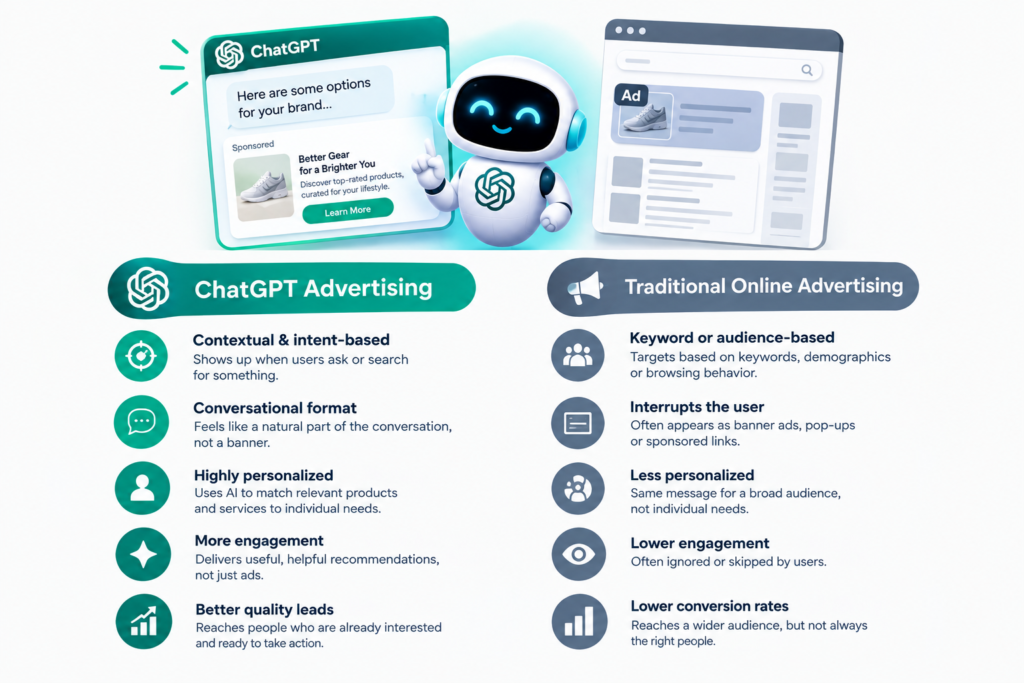
Chat GPT Ads, Google Ads, and Meta Ads all provide digital advertising opportunities, but they operate within different user environments.
Google Ads are closely connected with search behavior.
A person enters a query and receives search results, which may include sponsored listings depending on the search and campaign setup.
Meta Ads operate primarily within social environments such as Facebook and Instagram, where users discover content while browsing feeds, stories, reels, and other experiences.
Chat GPT Ads operate within a conversational environment.
The user may be asking questions, comparing alternatives, exploring ideas, or seeking recommendations.
This creates an important difference between search intent and conversational intent.
Google often starts with a direct query.
ChatGPT can involve a longer conversation where the user’s needs become clearer through multiple questions and responses.
This gives Chat GPT advertising a different context for relevance.
OpenAI says its advertising system considers the context and intent of the current conversation, along with other signals such as the ad’s landing page, title, copy, and advertiser-provided context hints.
Targeting is also different.
Google advertising has traditionally been strongly associated with search keywords and search intent.
Meta advertising is known for its social and audience-based advertising environment.
Chat GPT Ads use conversational context and relevance signals.
Creative requirements differ as well.
Google Ads often need concise search-oriented messaging.
Meta Ads commonly depend heavily on visual storytelling and social engagement.
Chat GPT Ads need clear and specific messaging that fits the context in which the user is exploring a need.
OpenAI’s current guidance recommends benefit-focused copy and multiple creative variations for different relevance opportunities.
Measurement also needs careful consideration.
All three platforms can provide performance data, but advertisers should not automatically compare metrics without considering differences in user behavior and campaign objectives.
For Chat GPT Ads, current reporting includes impressions, clicks, spend, CTR, average CPC, average CPM, and conversions.
Attribution can also become more complex when a customer interacts with several channels before converting.
A person may discover a product through social media, research it through ChatGPT, visit the website through search, and eventually purchase.
Therefore, Chat GPT Ads should generally be evaluated as part of the wider customer journey rather than in isolation.
Google Ads, Meta Ads, and Chat GPT Ads are not identical channels.
Each offers a different environment for reaching customers.
For marketers, understanding these differences can help determine where each platform fits within a broader digital advertising strategy.
How AI Is Changing Advertising Creative
Artificial intelligence is changing how advertising teams create, test, and optimize creative assets.
In traditional advertising workflows, producing multiple versions of an advertisement can take significant time.
Teams may need separate copywriters, designers, editors, translators, and analysts.
AI-powered advertising can help streamline parts of this process.
AI can assist with generating headline ideas, developing copy variations, creating visual concepts, adapting messages, and analyzing campaign results.
OpenAI is already introducing AI-assisted creative tools for Chat GPT Ads. Advertisers can receive suggested copy and imagery based on their landing page and campaign objective, while remaining in control of whether those suggestions are used.
This can make creative experimentation faster.
An advertiser can test several approaches instead of depending on one version.
For example, one creative may focus on price.
Another may focus on convenience.
A third may highlight a specific customer problem.
A fourth may focus on a product feature.
Different variations can help advertisers understand which message is more relevant to different customer situations.
Personalization is another important development.
OpenAI has also introduced AI-powered text customization that can adapt existing headlines and descriptions to better fit conversational context and translate copy into a user’s preferred language when enabled.
However, automation should not remove human creativity.
A brand still needs a recognizable identity.
Its tone, values, visual style, positioning, and messaging should remain consistent.
AI can generate possibilities, but marketers need to decide which ideas actually represent the brand.
This is especially important because more content does not automatically mean better advertising.
A campaign can contain hundreds of variations and still fail if the underlying message is unclear.
The strongest approach combines technology with strategy.
Marketers can use AI to accelerate production and testing while using human judgment to protect brand quality and relevance.
AI-powered advertising can therefore change the role of creative teams.
Instead of spending all their time producing individual assets, teams may spend more time developing concepts, reviewing AI-generated variations, interpreting performance data, and improving overall campaign strategy.
This also creates opportunities for smaller businesses.
Businesses with limited creative resources can potentially produce more advertising variations without building large internal teams.
The future of advertising creative is therefore unlikely to be purely human or purely automated.
It is more likely to be collaborative.
AI can handle repetitive and data-supported tasks.
Humans can provide strategy, creativity, judgment, and brand direction.
That balance will remain important as Chat GPT advertising and other AI-driven advertising platforms continue to develop.
Measuring Chat GPT advertising Performance
Measuring advertising performance is essential for understanding whether a campaign is achieving its business objective.
For Chat GPT advertising, marketers can monitor several important performance indicators through Ads Manager.
One of the basic metrics is impressions.
Impressions show how many times an advertisement was served.
This can be useful for campaigns focused on visibility and exposure.
Clicks are another important metric.
They indicate how many valid clicks an advertisement received.
From clicks and impressions, marketers can calculate click-through rate, or CTR, which helps show how frequently users clicked after seeing an ad.
Cost is another important consideration.
Advertisers can monitor campaign spending, average CPC, and average CPM depending on the campaign objective and billing model.
OpenAI’s current Ads Manager reporting includes impressions, clicks, spend, CTR, average CPC, average CPM, and conversions.
Conversions can be even more important for performance-focused campaigns.
A conversion might be a purchase, sign-up, lead submission, or another supported event.
Conversion-optimized Chat GPT Ads can be configured around selected conversion events and use different billing approaches depending on campaign setup.
ROI is another key business metric.
A campaign may generate many clicks but still be inefficient if those clicks do not lead to valuable outcomes.
Similarly, a campaign with fewer clicks may perform well if it generates high-quality leads or sales.
This is why marketers should connect advertising metrics with actual business results.
Chat GPT advertising should also be compared with other channels carefully.
A marketer might compare Chat GPT Ads with Google Ads, Meta Ads, or other platforms.
But the comparison should consider differences in objectives, audiences, customer intent, costs, conversion paths, and attribution.
A consistent measurement framework can make these comparisons more meaningful.
For example, a business can track:
- Impressions
- CTR
- CPC
- Conversion rate
- Cost per conversion
- Total spend
- Revenue
- ROI
UTM parameters can also help businesses track traffic from Chat GPT Ads inside existing analytics systems.
The goal is not simply to collect more numbers.
The goal is to understand what those numbers mean.
If impressions are high but clicks are low, the creative or relevance may need attention.
If clicks are strong but conversions are weak, the landing page, offer, audience fit, or customer journey may need review.
If conversions are strong but costs are increasing, campaign efficiency may need optimization.
A structured measurement process helps marketers make those decisions.
As Chat GPT advertising develops, consistent measurement will become increasingly important for understanding how this emerging channel performs alongside established digital advertising platforms.
The Future of OpenAI Advertising
The future of Open AI advertising is likely to be shaped by the way people use conversational AI for discovery, research, comparison, and decision-making.
ChatGPT is increasingly becoming part of how people explore ideas and evaluate options.
This creates a new environment for advertising.
Instead of advertising only around a search query or social feed, businesses can potentially reach customers while they are having a conversation about a specific need.
This is one reason conversational advertising is attracting attention.
The experience can connect advertising with customer intent in a different way.
OpenAI is already expanding its advertising technology beyond basic ad placements.
In September 2026, OpenAI introduced new AI-powered experiences for Chat GPT Ads, including Sponsored Agents, AI-assisted campaign creation, AI creative tools, and integrations with HubSpot and Shopify.
Sponsored Agents are particularly notable because they explore what can happen after an advertisement is clicked.
Instead of simply sending someone to a traditional landing page, a user can start a conversation with a business-sponsored agent.
This points toward a potentially more interactive advertising experience.
The development of AI-native advertising may also change how campaigns are managed.
OpenAI has introduced tools that allow advertisers to use natural-language prompts to create, update, and analyze campaigns.
This could make campaign management more accessible to businesses and marketing teams.
Creative production may also become increasingly automated.
AI can help generate different messages, suggest imagery, adapt copy, and support campaign analysis.
At the same time, human oversight remains important.
Advertising needs to remain accurate, useful, transparent, and consistent with a brand’s identity.
For agencies, this could create new services around conversational advertising strategy, creative development, campaign management, measurement, and optimization.
For brands, it could create another path for product and service discovery.
For consumers, the experience may increasingly connect information, recommendations, and commercial opportunities within the same conversational environment.
However, the future of Chat GPT Ads will depend on adoption, user experience, advertising effectiveness, trust, and how the platform continues to evolve.
Businesses should therefore view conversational advertising as an emerging channel rather than assuming that it will replace traditional advertising.
The broader trend is clear: AI-powered advertising is becoming more integrated into digital marketing.
As customers increasingly use AI to explore and make decisions, advertisers will need to understand how these new environments work.
Chat GPT Ads could become one part of a broader digital marketing strategy that combines search, social, content, websites, email, and conversational AI.
How Businesses Should Prepare for Chat GPT Ads
Businesses interested in Chat GPT Ads should begin with the fundamentals.
The first step is clear messaging.
Customers should quickly understand what a business offers, who it serves, and what problem it solves.
This becomes especially important in conversational environments where relevance depends heavily on context.
Businesses should also study customer questions.
What problems do customers ask about?
What comparisons do they make?
What concerns do they have before purchasing?
What information do they need before contacting a business?
These questions can help marketers understand conversational intent.
They can also help shape advertising messages and context hints.
OpenAI recommends context hints that clearly describe what a product or service offers, who it helps, and when it may be useful.
Creative preparation is another important step.
Businesses should develop multiple headlines, descriptions, images, value propositions, and landing-page approaches.
Different creative variations can help marketers test different customer needs and messaging angles.
Testing should be gradual.
Instead of immediately moving a large advertising budget into a new channel, businesses can begin with a clearly defined objective, appropriate budget, and measurable conversion goal.
Current Chat GPT Ads campaigns support objectives such as Views, Clicks, and Conversions.
Measurement should be established before launching.
Businesses should know which metrics matter to them.
For some campaigns, that may be visibility.
For others, it may be website traffic, leads, purchases, or another conversion.
UTM parameters and conversion tracking can also help connect Chat GPT Ads activity with broader analytics and business results.
Optimization should then become an ongoing process.
Marketers can review performance, identify stronger messages, adjust campaigns, and test new creative approaches.
Most importantly, Chat GPT Ads should not operate separately from the rest of the marketing strategy.
A customer may discover a business through ChatGPT, visit its website through another channel, see a social media advertisement later, and eventually convert through search.
A connected strategy can help businesses understand this broader journey.
This is where AI-powered advertising can become part of a larger marketing system.
Businesses can combine conversational advertising with SEO, Google Ads, Meta Ads, social media, content marketing, email, and other channels.
The objective is not simply to advertise everywhere.
It is to create a consistent customer experience across the places where people discover, evaluate, and choose products or services.
Conclusion: What Chat GPT Ads Mean for the Advertising Industry
Chat GPT Ads represent an important development in the evolution of digital advertising.
They introduce advertising into a conversational environment where people can explore questions, compare options, research products, and make decisions.
That creates a different context for advertisers.
Traditional digital advertising often focuses on keywords, audiences, placements, or social behavior.
Chat GPT advertising adds conversational context and user intent to the advertising experience.
For brands, this can create new opportunities for visibility during product and service discovery.
For agencies, it introduces another channel to consider when building integrated media strategies.
For advertisers, it creates new requirements around customer intent, relevant messaging, creative testing, campaign management, and measurement.
The role of relevance becomes especially important.
A generic advertisement may not be enough.
Businesses need to explain what they offer, who it is for, and why it may be useful in a particular situation.
Creative strategy will also continue to evolve.
AI can help advertisers produce variations, analyze campaigns, and optimize workflows.
OpenAI is already adding AI-assisted tools for campaign creation, creative development, and performance analysis.
This is where AI-powered advertising becomes particularly significant.
The future is not simply about using AI to create advertisements faster.
It is about using AI to understand context, support relevance, improve campaign workflows, and create advertising experiences that fit changing customer behavior.
At the same time, transparency remains essential.
Ads need to be clearly identified and kept separate from the answers users receive. OpenAI currently describes these principles as part of its approach to advertising in ChatGPT.
Measurement will remain equally important.
Businesses need reliable frameworks for evaluating impressions, clicks, conversions, spending, cost efficiency, and overall business outcomes.
Open AI advertising is still an evolving part of the digital advertising ecosystem.
Its long-term role will depend on how businesses use the platform, how customers respond to advertising within conversational environments, and how the technology continues to develop.
For brands, agencies, and advertisers, the practical takeaway is to start understanding the channel, its advertising formats, its measurement systems, and its relevance-based approach.
Chat GPT Ads may become another important part of the broader digital marketing mix.
And as AI-powered advertising continues to develop, businesses that understand conversational customer journeys will have more tools available to connect with audiences in new digital environments.